
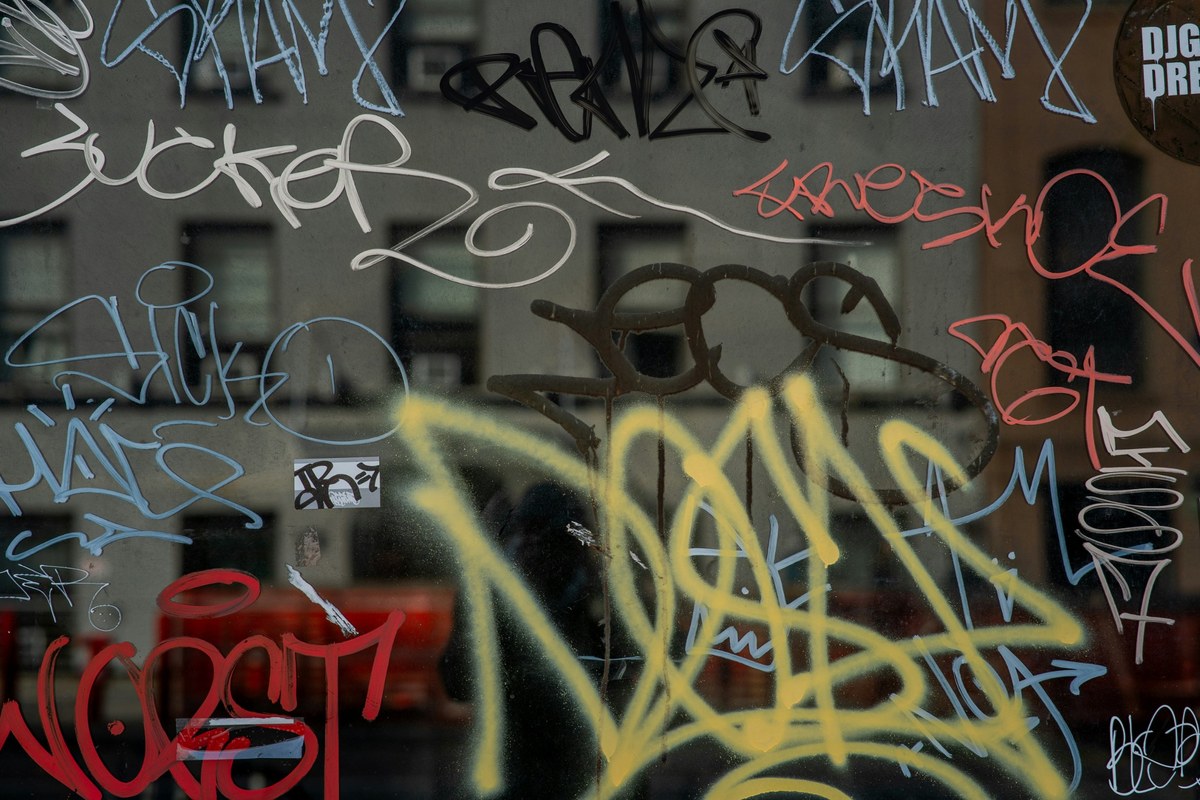
Anti-graffiti film
A clear sacrificial layer over your glass. When it gets tagged, scratched or etched, we peel it off and fit a new one. That is a short visit instead of a glazing job, and often the storefront can stay open.
Anti-graffiti film is a thin, hard-coated polyester laminate bonded to the exposed face of glass, mirror or polished metal. It is designed to be removed and replaced — that is the entire point. The film is sacrificial.
It does not stop anyone tagging, scratching or etching your property. What it changes is what that costs you. Damage lands on a replaceable layer rather than on the substrate, so remediation becomes a scheduled film change by one installer instead of a glazier, a crane, a custom-cut pane and a boarded-up storefront.
You can leave it in place indefinitely and replace only the panels that get hit.
Cross-section of a pane with an anti-graffiti film on its outside face. In (1) the film sits on the glass. In (2) damage lands on the film, not the glass. In (3) the damaged film is peeled off and a new film is fitted.
What it handles
Tagging is the one people think of. It is not the only kind of damage glass takes.
Spray paint, marker and ink sit on the film. Marks that do not come off are handled by replacing the film, not the glass.
Storefronts, parking structures, transit shelters, rear elevationsKeys, blades, rings, drill bits. Scratched glass is usually replaced rather than repaired. With film on, the scratch is in the film.
Lifts, transit windows, restrooms, display casesEtching cream and hydrofluoric compounds can permanently etch glass. Film takes the chemical burn and is replaced; the glass underneath is untouched.
Transit, schools, public restroomsNot vandalism at all, and a common cause of damaged glass in Utah. Sprinkler overspray and wash-down water leave mineral deposits that etch into glass over months. Once it is etched into the glass it does not come out.
Any building with irrigation near the glass, car washes, wash baysThe economics
We are not going to print a savings percentage, because the honest answer depends on your glass and how often you get hit. What we can do is lay out the two paths side by side so you can put your own figures against them.
| Replacing the glass | Replacing the film | |
|---|---|---|
| Who comes out | Glazier, often two for anything large or high | One installer |
| Lead time | Pane measured, ordered, cut — days to weeks for anything non-standard, tempered or insulated | Stock film, cut on site |
| In the meantime | Boarded or taped. Visibly damaged frontage, which invites more of the same | Nothing — the glass is intact the whole time |
| Disruption | Glazing work during or outside trading hours, usually with the opening out of service | Short visit, often outside hours, no opening lost |
| Insurance | Often an insurance claim, with a deductible | Often handled as maintenance instead of a claim, depending on your policy and deductible |
| If it happens again | The whole cost again | The film cost again |
Count the panes you have replaced in the last two years because of damage. Multiply by what each one cost you, all in — glass, labor, downtime, the claim.
Film the panes that actually get hit, not every pane you own. Most sites have a handful of repeat offenders: the rear door, the lift, the two bays nearest the parking lot.
If you have not replaced a pane in two years, you probably do not need this. We will tell you that on site rather than quoting you anyway.
Surfaces
Anti-graffiti film is not only for storefront glass. It can also go on other smooth, flat surfaces that take wear or get tagged, such as mirrors and finished metal. We confirm the film for your surface on the site survey.
| Surface | Why it gets filmed | Notes |
|---|---|---|
| Glass | Storefronts, entry doors, display cases, balustrades, transit glazing. The default application. | Clear film; you should not see it |
| Mirrors | Restroom and changing-room mirrors get scratched often, and a replacement mirror is a bigger job than a pane. | Mirror-specific film |
| Polished and brushed metal | Lift interiors, door push plates, handrails, stainless panels. Scratched stainless is usually replaced rather than repaired. | Metal-grade film, often brushed to match |
| Other smooth, flat surfaces | Any smooth, flat surface that gets tagged, scratched or worn, such as elevator panels, restroom partitions and signage panels. We check it at the survey. | Checked on site |
Replacement programs
If you manage transit assets, a retail portfolio, parking structures or schools, the useful arrangement is not a quote every time something happens. It is a standing agreement: we hold the film spec for your sites, you report damage, we replace it inside an agreed window.
That turns an unpredictable capital problem into a line item you can budget. It also means the damaged panel is gone quickly — which matters, because visible damage attracts more of it.
We walk the site, identify the panels that actually take damage, and record the film, size and surface for each one.
Filmed once, scheduled around your hours. After this, every incident is a replacement rather than a new job.
You tell us what got hit; we replace it within 5 to 7 business days. Standing rate, so there is no quoting cycle per incident.
| Program terms | What we commit to |
|---|---|
| Standard response | Replacement within 5 to 7 business days of you reporting it |
| Pricing | Standing per-panel rate agreed at survey. No re-quote per incident. Rates are reviewed each year and may increase. |
| Payment | A deposit schedules the work, with the balance due on completion. We accept purchase orders, and terms for larger projects are set out in the written scope. |
| Insurance | Insured for commercial work; certificate on request |
We publish the response window because it is the thing you are actually buying. A commitment we can hold in July is worth more than a faster one we would miss.
Where it goes
Street-facing glass, entry doors and display cases. Damaged frontage affects how the business looks to the street.
Restroom mirrors, corridor glazing and entry doors. Scratching and etching more often than paint.
Stair cores, lift lobbies and payment kiosks. Low supervision, high repeat rate.
Not vandalism — chemistry. Repeated wash water and hard water etch glass permanently, and the film takes it instead.
Any building where sprinklers reach the glass. The damage is slow, permanent and almost always unnoticed until it is severe.
Shelters, platform glazing and wayfinding panels, where glass takes repeated damage and is awkward to replace in service.
Other places where we are asked to protect glass, mirrors and polished metal.
Anti-graffiti FAQs
No, and anyone saying otherwise is overselling it. It does not deter anybody — it is invisible. What it does is make the damage cheap to undo, so an incident becomes a short maintenance visit instead of a glazing job and an insurance claim.
On a clean install, no. It is optically clear with a hard scratch-resistant coat, and from inside or outside the glass reads as glass. On mirrors and brushed metal we use the product made for that surface so the finish matches.
Until something damages it. There is no service interval — a filmed pane that never gets hit can stay as it is for years. Exterior applications in Utah’s UV and temperature range work harder than interior ones, and we will tell you the manufacturer’s expected life for the exact product on your quote.
Often yes — a clear anti-graffiti layer over solar control or decorative film protects the costly layer underneath, which is a sensible build-up on a vulnerable elevation. It depends on what is already there and how it was installed, so we check rather than assume.
It is designed to come off without damaging the glass. We check the glass first, and we tell you if anything on the glass would make removal a problem.
Film does not undo existing etching. If the damage is already in the glass, filming over it locks in the appearance. Light mineral deposit can sometimes be restored first and then filmed to stop it recurring; severe etching means replacing that pane once and filming the new one. We will tell you honestly which situation you are in.
On the face that takes the damage. For street-facing glass that is the outside. For restroom glass, mirrors and interior glass it is the inside. We decide that opening by opening.
Yes. Anti-graffiti film can go on mirrors and on smooth finished metal, as well as glass. We confirm the right film for your surface on the site survey.
Yes — portfolios across several buildings are a good fit, including a standing replacement arrangement. See replacement programs.
Related
Where we install it
Free site survey, no obligation. We identify the panels that actually get hit, and tell you if you don’t need this.